Microexons: Synaptic Plasticity Depends on Precision. Precision Lives Here.
Consider a synaptic protein with hundreds of amino acids and dozens of interaction partners. Now imagine that six nucleotides, spliced in or out depending on cell type and timing, can shift which partners it binds and how strongly. No new gene required. Just a small, precise edit at exactly the right place in the sequence. That is what microexons do, and the brain is exceptionally adept at utilizing them.
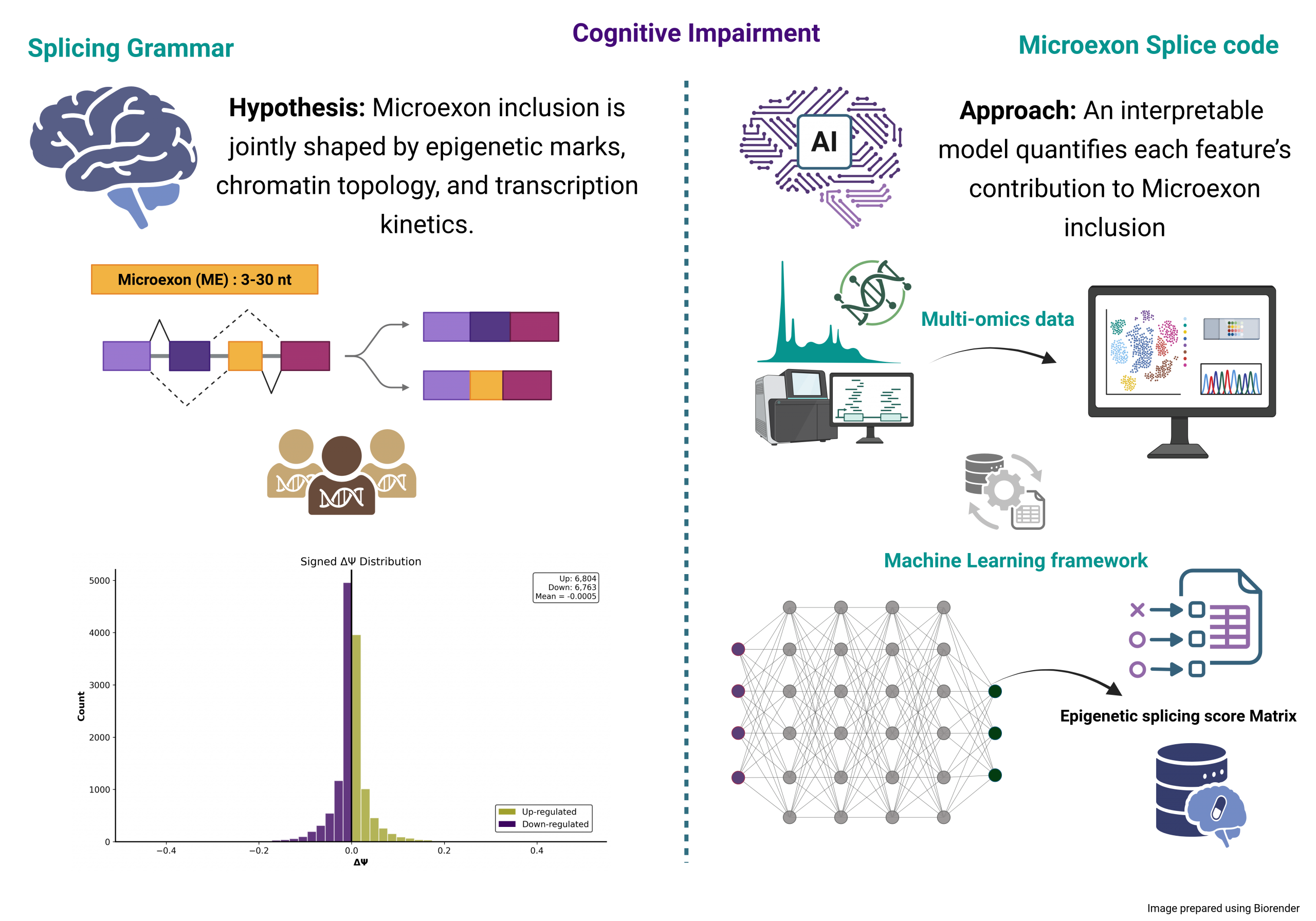
Defined by their length of just 3 to 30 nucleotides, microexons insert or remove a handful of amino acids at protein interaction surfaces with a precision that larger splicing events cannot match. During brain development, the splicing factor nSR100 orchestrates a conserved program of neuronal microexon inclusion, tuning the synaptic proteome at precisely the window when circuits are being formed. That this is conserved across vertebrate species is not coincidence. It points to something essential.
The clearest proof came from autism research. In the late 2000s, studies showed that this neuronal microexon program is coordinately misregulated in autistic brains, with dozens of inclusion events shifting together across individuals. One regulatory perturbation, rippling through a network of precisely tuned splicing decisions, producing a coherent disease signature. The pattern has since extended to schizophrenia, metabolic disorders, and cancer. Taken together, these findings made one thing clear: microexons are not a curiosity. They are a mechanism.
Which makes one question all the more striking: what happens to these programs as the brain ages? Surprisingly, this has barely been asked. The regulatory machinery governing microexon inclusion persists in the adult brain, and its inputs shift with ageing and neurodegeneration. Age-related changes are biologically expected, and synaptic resilience may be among the first casualties. Across six cognitive stages spanning healthy ageing through Alzheimer’s disease, 1,647 microexon events have now been identified in the human cortex, building the first foundational reference for microexon biology in the ageing brain.
But description is where too many splicing studies stop. What drives this lab is a simple but underexplored idea: microexon inclusion is a coordinated regulatory output shaped by splicing grammar, sequence features, chromatin accessibility, epigenetic state, and transcriptional kinetics, and understanding why inclusion changes matters as much as documenting that it does. The long-term goal is an interpretable computational framework that attributes regulatory contributions across these layers, resolved by disease stage, grounded in cell-type context, and designed to produce hypotheses specific enough to test and grounded enough to inform where and when intervention actually makes sense. Synaptic plasticity depends on precision. Understanding that precision, computationally and mechanistically, is what this lab is building toward.